
Makes the argument land.
The belief-sequencing pillar of Huegoo's Intelligence Engine. It shapes the Big Idea, structure, evidence order, and headline logic that take the room from context to conviction to action.
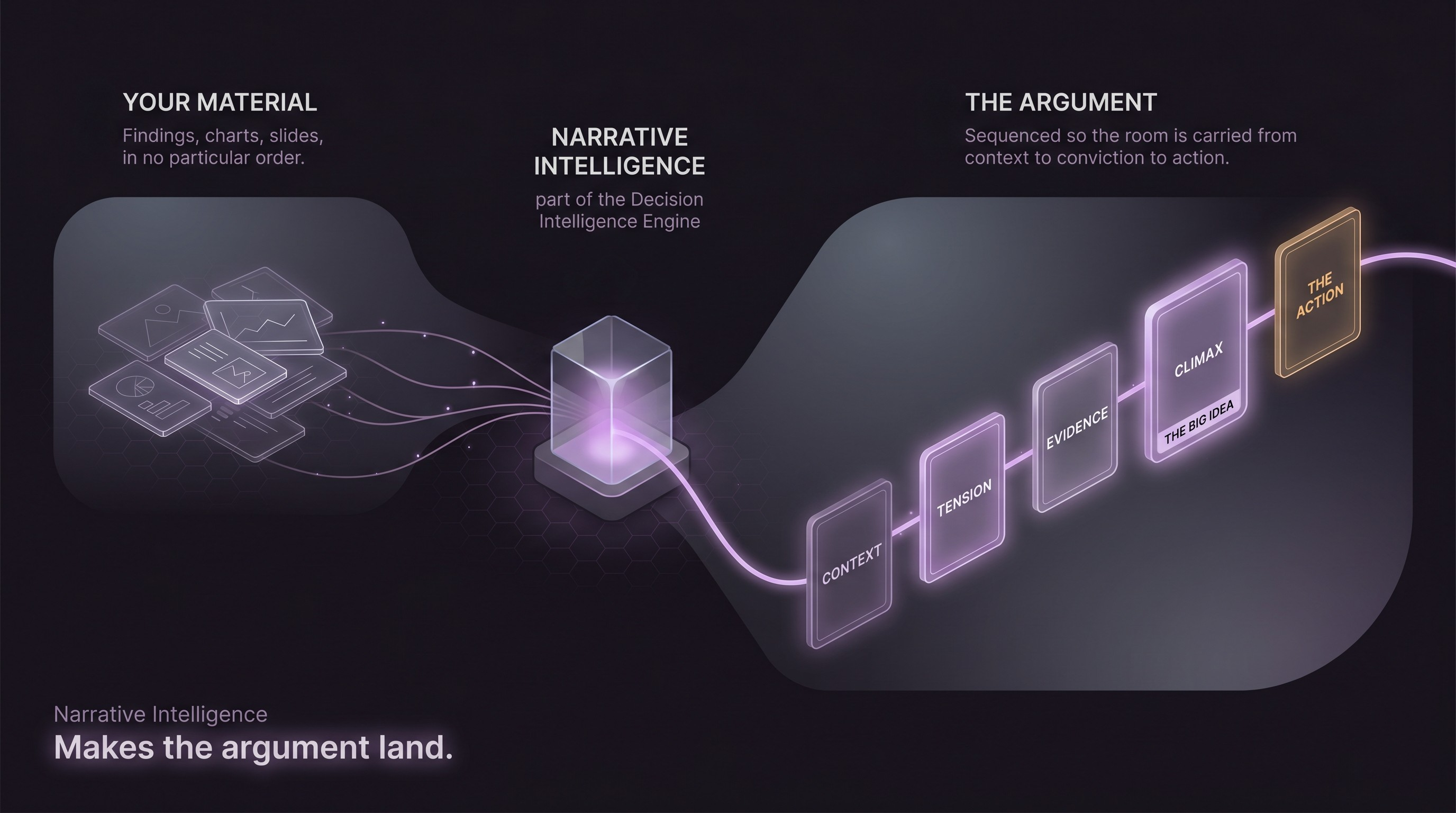
Right data, wrong order
You have seen this. Two decks. Same data. Same audience. One gets approved in twenty minutes. The other gets "thanks, let us come back to this" after forty.
The difference is rarely the analysis. It is the order things appeared in, and how each beat handed off to the next.
Information by itself does not move people. Sequence does. A recommendation with the right evidence in the wrong order is a recommendation that lands flat, even when everything underneath it is correct.
Narrative Intelligence is the pillar that decides that order.
Inside the belief-sequencing pillar
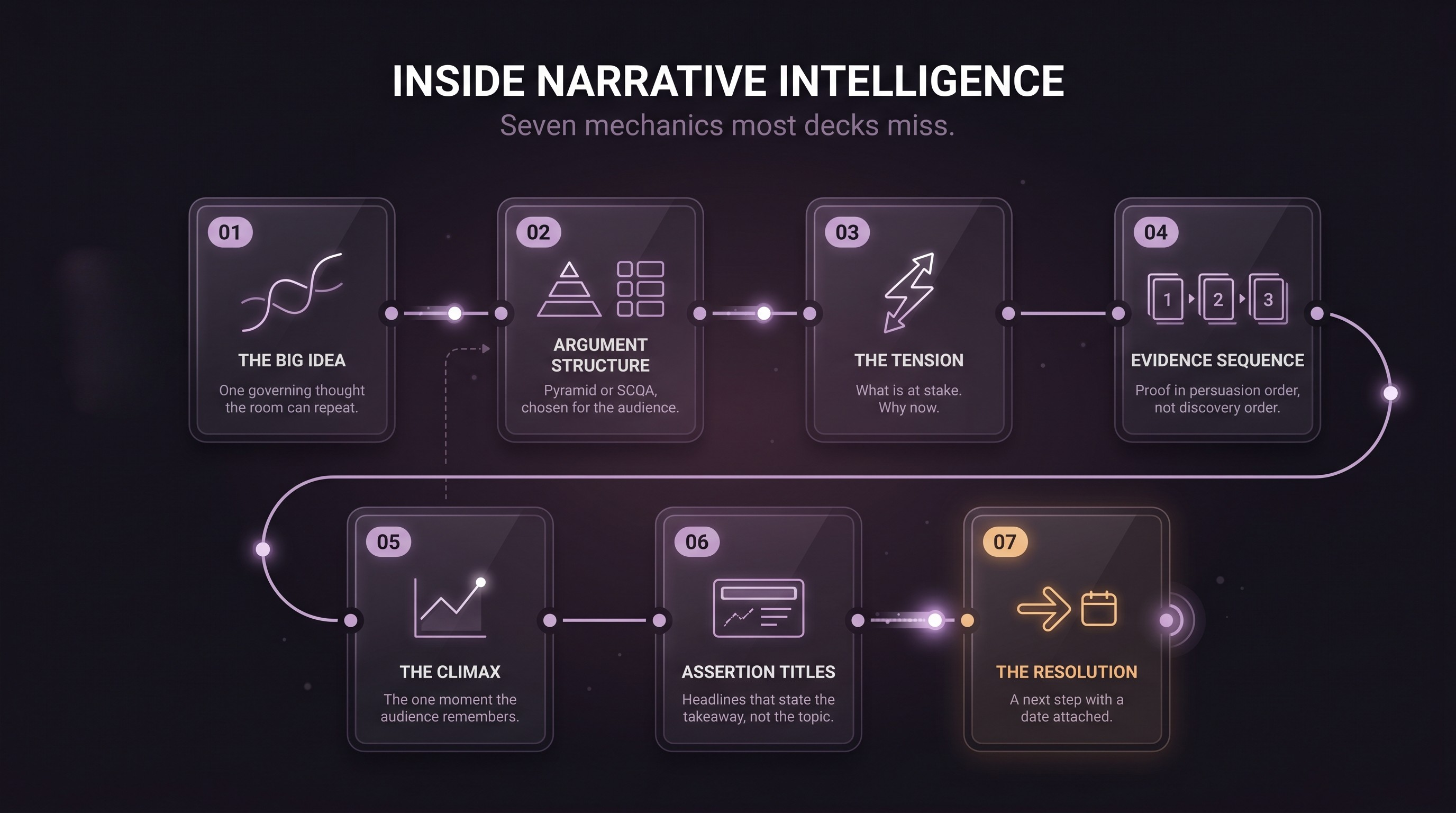
Narrative Intelligence turns the strategic signal and the vertical proof into an executive story the audience can follow, agree with, and act on. It is the part of the engine that handles the seven mechanics most decks miss.
- 01
The Big Idea.
Compresses the recommendation into one governing thought. The thing the audience can repeat to the next person they speak to. Most decks have no Big Idea, which is why most decks are forgotten.
- 02
The argument structure.
Pyramid when the audience is aligned and wants the answer first. SCQA when the room needs the context before it can hear the recommendation. The structure is chosen for the audience, not by default.
- 03
The tension.
Names what is at stake and why now. Without tension, the deck reads as a report. With it, the room understands why this decision cannot wait.
- 04
The evidence sequence.
Orders proof for persuasion, not for the order it was discovered. Aligned audiences get confirmation first. Skeptical audiences get the most contrarian piece of evidence first. Resistant audiences get the cost of inaction first.
- 05
The climax.
Designs the one moment the audience will remember a week later. One chart, one number, one comparison. Placed where the room is most receptive.
- 06
Assertion titles.
Headlines that state the takeaway, not the topic. A senior reader can flip through the deck and follow the argument from titles alone. If they cannot, the deck is not done.
- 07
The resolution.
Closes on the next action, with the date attached. Not a summary. Not a thank-you slide. A sentence the audience can act on the moment the meeting ends.
Meetings that close with a decision
-
Recommendations move the room they are built for.
The audience is carried from context to conviction to action by design, not by accident.
-
The Big Idea sticks.
Senior leaders walk out able to repeat the recommendation in one sentence to the next person they meet. That single fact is what makes a decision outlast the meeting.
-
Headlines do the work.
The argument is readable from the section titles alone. The audience does not have to assemble the story themselves.
-
The action becomes unavoidable.
The recommendation closes on a defined next step. The audience does not construct the action; they approve, modify, or reject the one in front of them.