
Finds what matters. Proves what should.
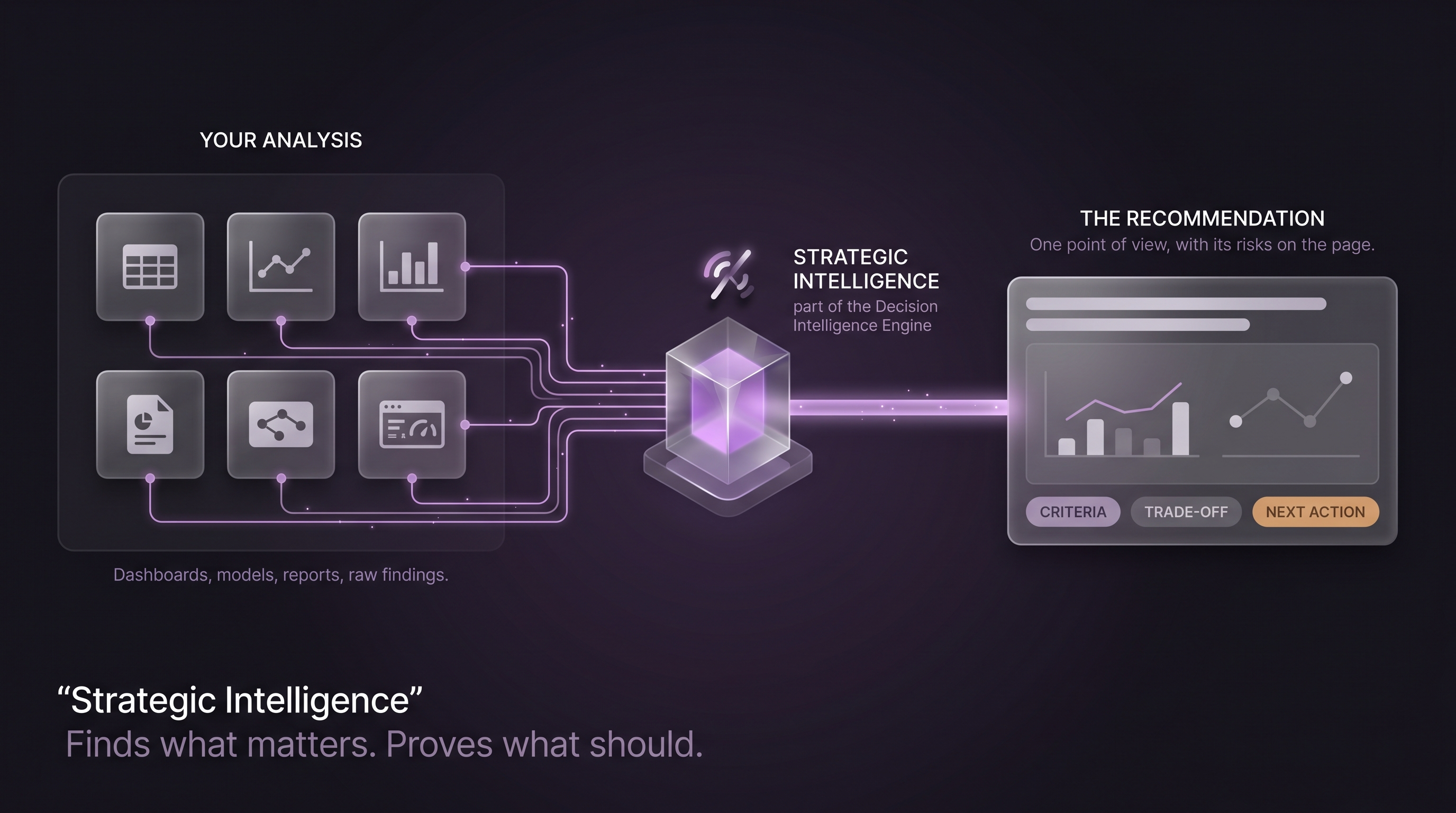
The signal-finding pillar of Huegoo's Intelligence Engine. It reads the work, extracts the pattern that should drive the decision, and turns it into a recommendation the room can act on.
Where the signal gets lost
A complex decision has too much information around it, and not enough of it is useful.
The dashboards refresh. The analysis lands in a folder. The team builds a deck. By the time the recommendation reaches the room, the signal has been diluted into a balanced summary that asks the audience to do the synthesis.
Strategic Intelligence is the pillar that does the synthesis first.
Inside the signal-finding pillar
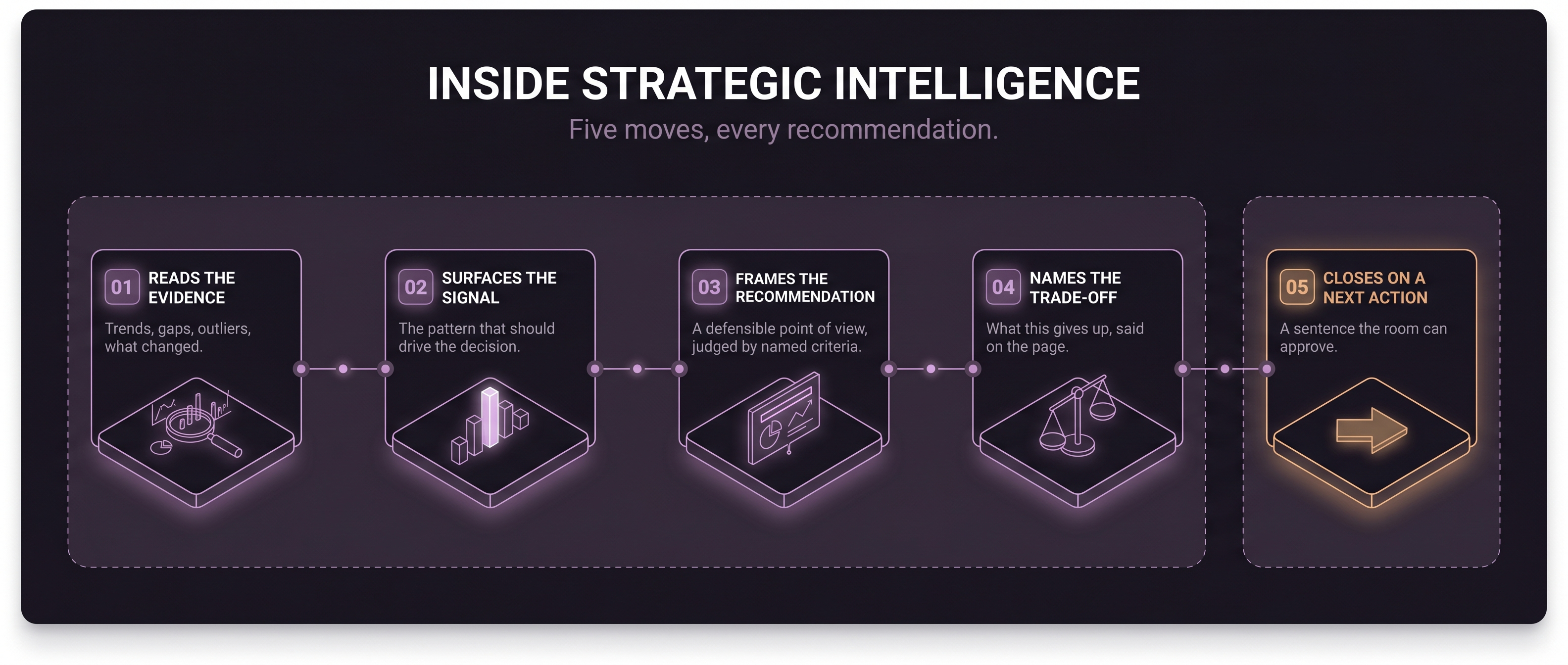
Strategic Intelligence reads the underlying evidence and resolves the question every executive deck must answer before it is built: what is this decision actually about, and what should the room conclude?
It does five things.
- 01
Reads the evidence for patterns.
Trends, gaps, outliers, shifts, risks, and opportunities. It scans the work for what changed, what is underperforming, what pattern repeats, and what the data is quietly insisting on.
- 02
Surfaces the signal that should drive the decision.
Not the most interesting finding. The one most likely to change the audience's mind. The pillar separates evidence that moves a decision from evidence that just shows the work was done.
- 03
Frames the recommendation.
A single defensible point of view, not three balanced options. With the criteria the audience should judge it by, named on the page.
- 04
Names the trade-off.
Every recommendation gives something up. The pillar says what, in the same breath as the recommendation, so the room is not surprised in week six.
- 05
Closes on a next action.
A sentence the audience can approve or reject the moment the meeting ends. Decision, not discussion.
What changes in the room
-
Decisions stop being assembled in the room.
The senior leader walks in to evaluate a recommendation, not to construct one from the slides in front of them.
-
The signal does not get diluted.
What the data is saying makes it to the cover slide, not slide 23.
-
Trade-offs are owned in advance.
Every recommendation walks in with its risk surface visible. Trust compounds.
-
The room moves to action.
Decisions land in the meeting they were made for. They stop sliding to the next quarter.