
Knows what your domain trusts.
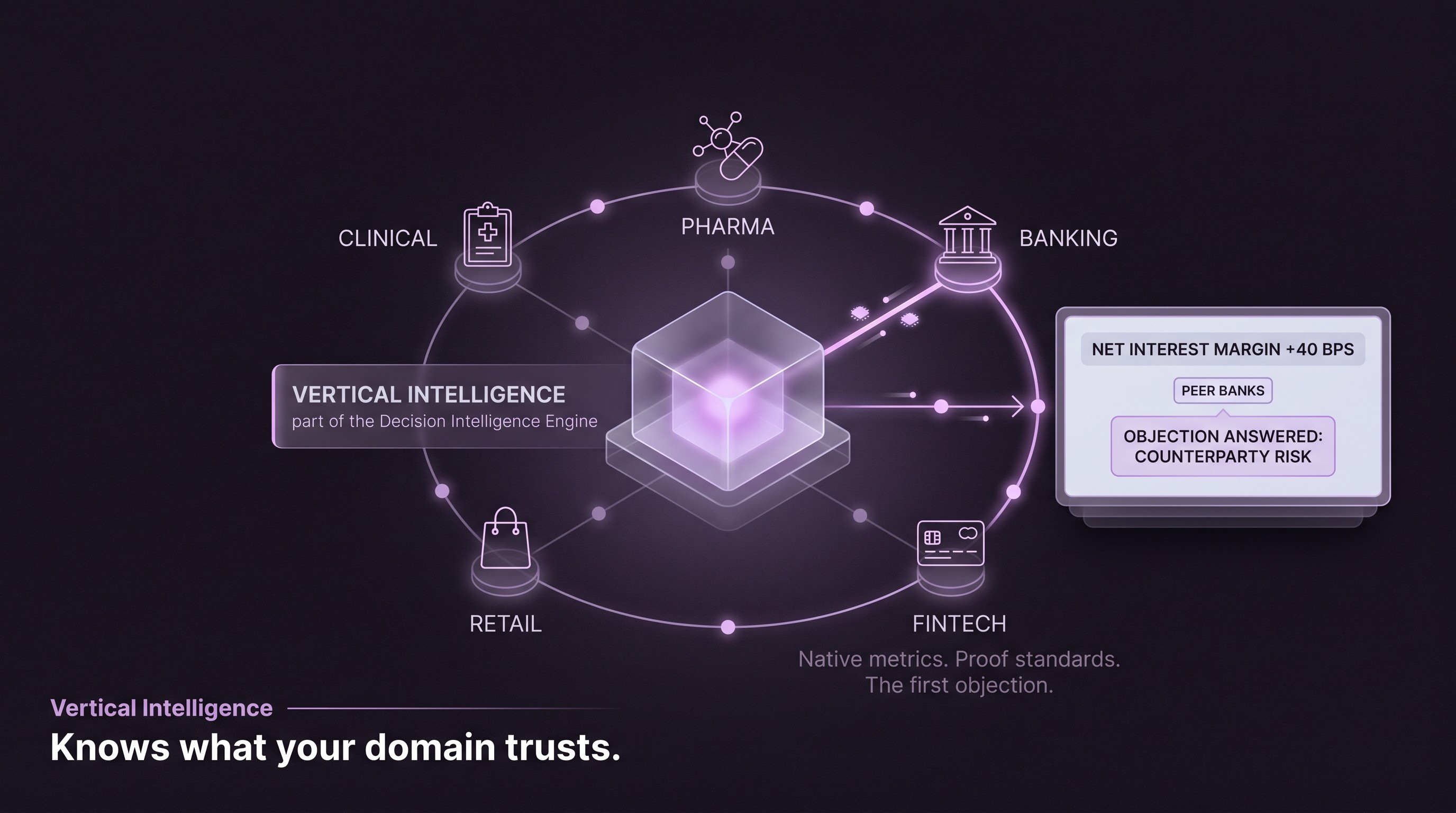
The context-calibration pillar of Huegoo's Intelligence Engine. It carries the metrics, language, proof standards, and objections of your industry into every recommendation, so the deck belongs in the room.
Why a generic recommendation never lands
Generic recommendations get pattern-matched out of the room.
A pharma board does not weigh a Phase 2 program the way a SaaS board weighs a new GTM motion. A fintech CRO does not read risk the way a consumer goods CFO reads it. A clinical committee, an investment committee, and a regulatory committee live in different worlds, with different proof, different vocabulary, and different first objections.
A recommendation that ignores that pattern reads as outsider work. The room never gets to the substance.
Vertical Intelligence is the pillar that makes sure that does not happen.
Inside the context-calibration pillar
Vertical Intelligence calibrates the recommendation to the specific industry, function, and decision context it is being made in. It is what separates a generic argument from one a regulated industry actually trusts.
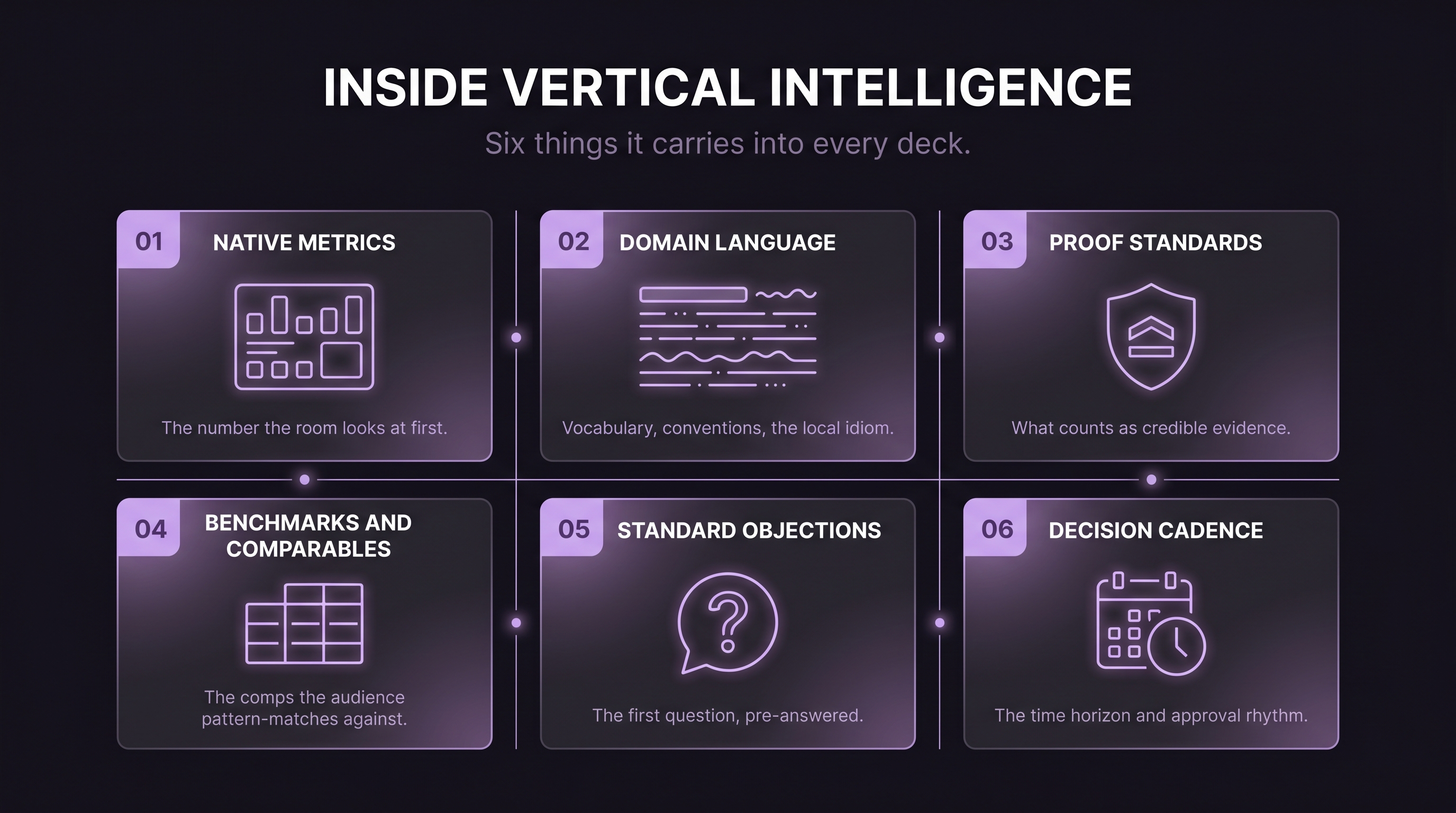
It carries six things into every deck.
- 01
Native metrics.
The numbers the audience actually looks at first. Net revenue retention in SaaS. Cost per acquired patient in pharma. Net interest margin in banking. The recommendation leads with the metric that lives at the top of the audience's dashboard.
- 02
Domain language.
The vocabulary, conventions, and abbreviations that signal native-speaker fluency. The deck speaks the audience's idiom without translation.
- 03
Proof standards.
What counts as credible evidence in this domain. Randomized trials weigh more than retrospective studies in clinical contexts. Audited financials weigh more than management estimates in investor contexts. The hierarchy is respected.
- 04
Benchmarks and comparables.
The peers, transactions, and precedents the audience will pattern-match against. Wrong comp set, wrong recommendation.
- 05
Standard objections.
Every industry has a question that always comes first. Regulatory exposure in pharma. Counterparty risk in finance. Channel cannibalization in consumer. The pillar pre-answers it on the page.
- 06
Decision cadence.
The time horizon and approval rhythm the industry runs on. A ten-year R&D bet is structured differently than a one-quarter pricing call.
When industry filters stop firing
-
The recommendation reads as native.
The audience moves past the "do these people understand our world" check in the first paragraph. Trust starts where it should: at the substance.
-
The first objection is already answered.
The meeting spends its time pressure-testing the decision, not on the question the room always asks first.
-
Cross-industry teams stop sounding cross-industry.
A holding company can make pharma, fintech, and consumer decisions in the same week, with each deck reading as if it was written by someone who lives in that world.
-
The regulatory surface is visible.
Live obligations and constraints show up on the page, not in execution.