
Humanoid Robots: The Data Gap That Capital Cannot Buy
- CEOs
- Consulting
- Generic
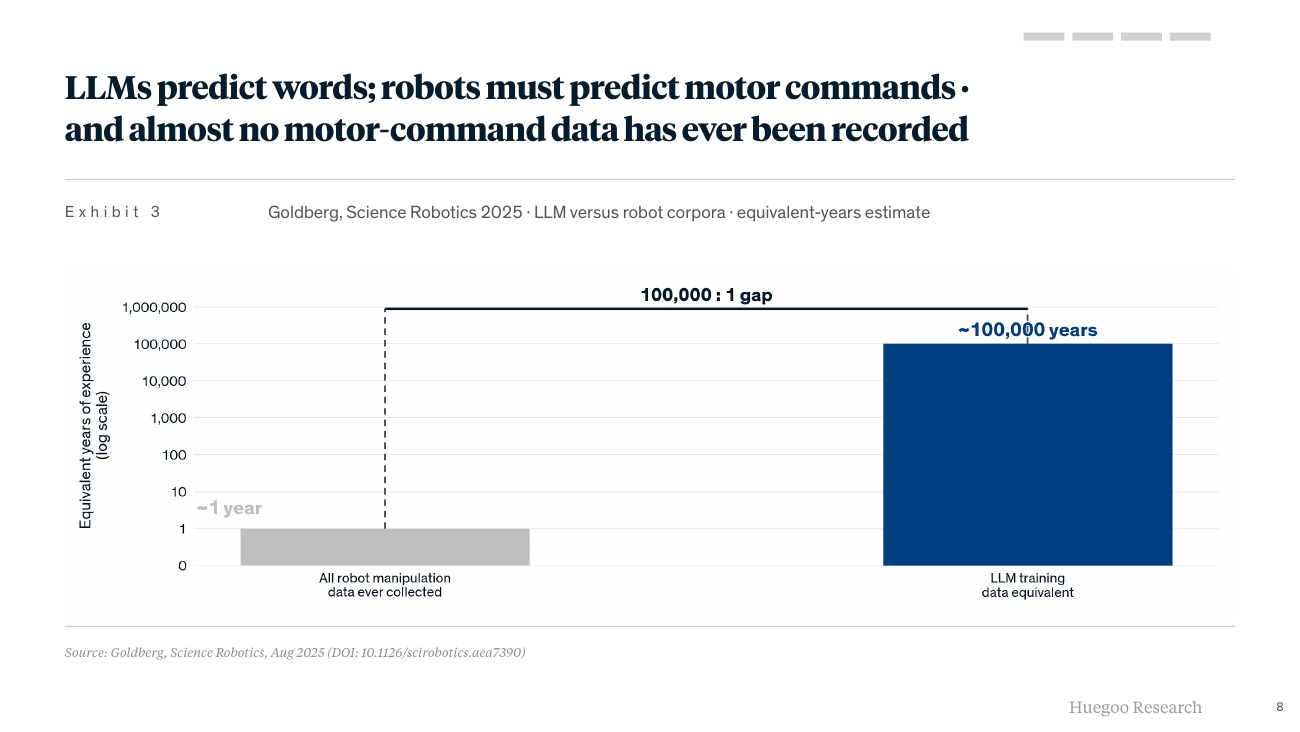
Humanoid robots crossed from demo to pilot, and the capital is real: four banks project a $38B to $7T market and humanoid-specific VC reached $2.84B in 2025. But this readout argues the binding constraint is not funding. A structural 100,000-to-1 robot-data gap, an unsolved dexterity problem stuck near 30 percent success on unstructured tasks, and a China-controlled actuator supply chain gate the timeline. The conclusion for an investment committee is to underwrite supply chain and narrow first use-cases, not the headline TAM.
The deck.
Citations on every slide, sourced back to the row, sheet, or cell behind each claim.
1/–
Click either side of the slide, or use the arrow keys.
The brief.
What we told Huegoo before generation.
Audience. An industrial-technology investment committee weighing humanoid-robotics exposure.
Occasion. An investment-committee readout on where to concentrate humanoid-robotics underwriting.
Time. 20 minutes.
Brief. The committee is weighing humanoid-robotics exposure at the loudest moment in the sector’s history. This deck holds four findings together: the hype is real and richly funded, the binding constraint is a data-and-dexterity gap that no check can directly fix, China controls the supply-chain high ground, and pilots confirm value only in narrow, supervised, structured settings. The structural anchor is a 100,000-to-1 gap between LLM training data and all robot manipulation data ever assembled. The decision it supports is to underwrite supply-chain independence and first use-case operators rather than the multi-trillion 2050 TAM.